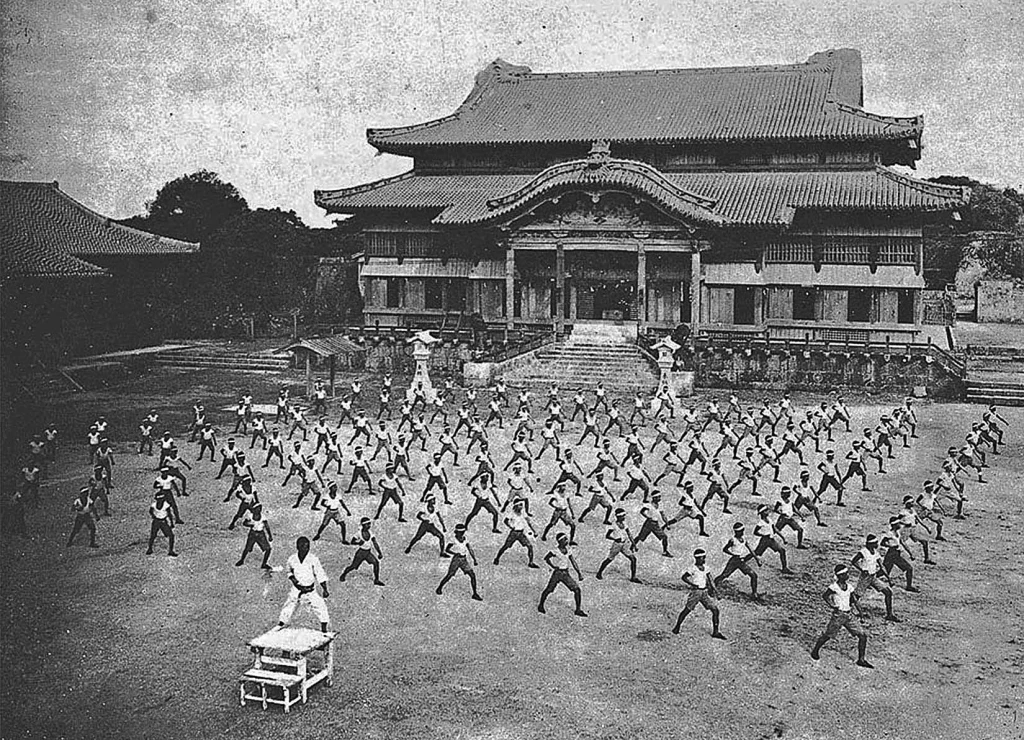
From Shuri-te to Shidōkan: History, Controversies, and Lineage of Shōrin-ryuū
Abstract
Shōrin-ryū is not a single organization but a family of Okinawan karate schools descended from the Shuri-te tradition. This article traces its development from the semi-legendary figures of the Ryūkyū Kingdom to the formation of Shōrin-ryū Shidōkan, founded by Katsuya Miyahira in 1948, and its international spread, with particular attention to Argentina. Along the way it examines five recurring points of dispute: chronological inconsistencies in the founding narrative, the pedagogical reform of kata, the origin of the name, contested lineage claims, and the confusion between two unrelated schools called Shidokan.
Keywords: Shōrin-ryū, Shuri-te, Okinawan karate, Itosu, Chibana, Miyahira, Shidōkan, lineage
1. Introduction
"Shorin Ryu" works as an umbrella term. The style diverged into many schools, and the name came to cover all of those derived from it. That fragmentation makes lineage the central problem of its history: each branch emerged from a person, a succession, or a dispute. Wikipedia
2. Sources and Methods
This review draws on encyclopedic entries, biographical pages published by schools and associations, and discussion forums. Many of these secondary sources, in turn, rely on a small set of published works: Clarke's Okinawan Karate: A History of Styles and Masters, Bishop's Okinawan Karate, and Sells's Unante. Claims that rest only on dojo websites or forums are flagged in the text as such. Dates vary between sources, and where they do, both are reported.
3. Origins: Shuri-te and Its Founding Figures
3.1 Sakugawa and Matsumura
The tradition places Tōde Sakugawa near the source of Okinawan karate. His most famous student, Matsumura Sōkon, went on to develop Shuri-te, which later gave rise to Shotokan, Shito-ryū, and Shōrin-ryū. Matsumura is credited with passing on kata including Naihanchi, Passai, Seisan, Chintō, Gojūshiho, and Kusanku, and his students included Itosu, both Motobu brothers, Kyan, and Funakoshi. WikipediaWikipedia
3.2 Dispute 1: Chronological inconsistency
The founding narrative contains a verifiable problem. If Sakugawa died in 1815 and Matsumura was born in 1809, as his tomb dates confirm, Matsumura would have been six years old at the time. The Sakugawa–Matsumura teaching relationship should therefore be treated as tradition rather than established fact. Published birth and death years for both men also vary between sources. worldbudokan
4. Itosu and the Reform of Kata
4.1 Pedagogical adaptation
Itosu created the Pinan forms because he judged the older kata too difficult for schoolchildren, and in 1908 he wrote the "Ten Precepts of Karate" to reach Japan's education and war ministries. Wikipedia
4.2 Dispute 2: Simplification versus dilution
The reform divides opinion. Supporters see effective mass pedagogy; critics see a loss of combative content. The case of Motobu Chōki is often cited: under Itosu he found it hard to defeat his older brother in kumite, so he secretly continued training with Matsumura and Sakuma. The tension between school-oriented and combat-oriented karate persists throughout the twentieth century. Wikipedia
5. Chibana Chōshin and the Naming of Shōrin-ryū
5.1 Biography
Chibana (1885–1969) began studying under Itosu in 1899 and was the first to give a Japanese ryū name to an Okinawan karate style, calling Itosu's karate "Shōrin-ryū" in 1929. Another source places the naming in 1930 and uses the reading Kobayashi-ryū. He lost his family, dojo, and several students in the Battle of Okinawa, and rebuilt his teaching afterwards. Chōshin Chibana +2
5.2 Dispute 3: The meaning of the name
Tradition links "Shōrin" to the Shaolin temple, but the characters admit several readings (young forest, small forest, pine), and schools disagree on which is correct. What the sources support is that the name as a school label dates from the twentieth century, not from Matsumura's era.
6. The Kyan Lineage and the Shōbayashi Branch
A parallel lineage descends from Chōtoku Kyan. His students went on to lead their own branches: Nagamine (Matsubayashi-ryū), Tatsuo Shimabukuro (Isshin-ryū), Eizo Shimabukuro (Shōbayashi Shōrin-ryū), Nakazato (Shōrinji-ryū), and Zenryō Shimabukuro (Seibukan). The distinction between the Kobayashi line (Itosu–Chibana) and the Shōbayashi line (Kyan) is therefore one of lineage and emphasis. Wikipedia
Isshin-ryū illustrates how far hybridization can go. Tatsuo Shimabuku combined what he judged the best of Shōrin-ryū and Gōjū-ryū with kobudō weapons and his own techniques. Wikipedia
7. Dispute 4: The Matsumura Seito Lineage
Hohan Soken (1889–1982) presented himself as heir to a family transmission of Matsumura's art. He reported beginning training at thirteen under his uncle Nabe Matsumura, officially renamed his teaching Matsumura Orthodox Shōrin-ryū in 1956, and stated that his was not the only authentic Shōrin-ryū. worldbudokan
Critics question the purity of this transmission. A forum discussion notes that Soken taught Tomari-te kata such as Chinto, Rohai, and Wansu, and at least two Pinan kata, which Bushi Matsumura relatively certainly did not teach. Later succession claims add further complexity: followers of Fusei Kise present him as sole true heir to the Matsumura orthodox tradition. These claims come largely from forums and organizational websites rather than academic historiography. martialtalkshuriway
8. After 1969: Fragmentation of the Chibana Line
8.1 Division of the association
After Chibana's death in 1969, Miyahira, his most senior student, received the organization's seals and was voted president of the Okinawa Shōrin-ryū Karate-dō Association. Chibana's senior students then divided the style: Miyahira headed the main branch, Nakazato formed Shōrinkan, Higa formed Kyūdōkan, and Nakama and Kinjō formed Kushin-ryū. In 1975 Nakazato resigned from the association and formed his own Shōrinkan Association. WikipediaWikipedia
8.2 Rank as a contextual claim
Five of Chibana's senior students were promoted to 9th dan, and many masters later reached 10th dan within their own associations. Rank in this context is institution-dependent and should be read as "ranked by which body." Wikipedia
9. Shōrin-ryū Shidōkan
9.1 Foundation and name
In October 1948, Katsuya Miyahira opened his first dojo in Kanehisa, Nishihara, after receiving his Shihan certificate from Chibana. The name Shidō (志道) comes from Confucius's Analects and expresses the resolve to follow the Way. Wikipedia
9.2 Technical characteristics
Like most Chibana-ha schools, Shidōkan is characterized by relatively high stances, quick, light movements, and explosive power. Kata common to its schools include Naihanchi, Pinan, Passai, Kusanku, Chinto, and Gojūshiho, plus Tetsu Shou, created by Miyahira. Wikipedia
9.3 Dispute 5: Two unrelated Shidokans
The Japanese Shidōkan (士道館) was founded by Yoshiji Soeno in 1981 as a knockdown karate style, and the Okinawan Shidōkan (志道館) predates it by 33 years. The two share a romanized name and nothing else in lineage, which causes frequent confusion in online searches. Wikipedia
10. International Expansion
In 1963 Seikichi Iha, a student of Miyahira, spent eleven months in Manila at the request of Latino Gonzalez, later taught in Guam and Los Angeles, and settled in Lansing, Michigan, where his dojo became headquarters of the Beikoku Shidokan Association. He died on 3 August 2024. Kazunori Yonamine began teaching Shidōkan in Brazil in 1990. European branches are led by figures such as Dikran Kevork in France and Joachim Laupp in Germany. Wikipedia
11. The Argentine Case
Shōei Miyazato moved to Argentina in 1959 and began teaching Shidōkan in Córdoba. In the early 1990s he left to head his own style but rejoined Miyahira's organization a few years later. After his death in 2013 his son Masatoshi took over; the organization reports over 90 affiliated dojos in Latin America and Europe and between 9,000 and 10,000 active students. In 1996 Jorge Garzón, a student of Takeshi Miyagi, himself a former student of Miyazato, re-established Shidōkan in Argentina with headquarters in La Plata. Two intertwined Shidōkan lines therefore coexist in the country. The membership figures are the organization's own and have not been independently verified. WikipediaWikipedia
References
- Clarke, C. M. Okinawan Karate: A History of Styles and Masters, Vol. 1: Shuri-te and Shorin-ryu.
- Bishop, M. Okinawan Karate (2nd ed.). Tuttle Publishing.
- Sells, J. Unante (2nd ed., 2000). W. M. Hawley.
- Wikipedia entries: Shōrin-ryū; Shōrin-ryū Shidōkan; Chōshin Chibana; Sōkon Matsumura; Ankō Itosu; Motobu Chōki; Sakugawa Kanga; Tatsuo Shimabuku; Shōbayashi Shōrin-ryū; Shōrin-ryū Shōrinkan.
- Okinawankarate.org, "Shorin Ryu (Shuri Te)."
- World Budokan, "History of Matsumura Shorin-Ryu Karate" and "Sokon Matsumura."
- Authentic Ancient Arts, "Our History."
- MartialTalk forum threads on Shorin-ryū lineage and Hohan Soken.
- Shuri Way, "Fusei Kise."
- Beikoku Shidokan Association (ihadojo.com) and Miyazato Dojo (miyazatodojo.com), organizational sources.